
STILLWATER / FIELD GUIDE
HUSH Death Penalty and Secure Case: What You Keep
Last updated:
A failed raid can cost you your loadout. Knowing which storage protects its contents helps you decide what to carry, what to secure, and whether a bigger case fits your needs.
Dying in a HUSH raid costs you your unprotected carried equipment and items. Items inside your secure case come home. The standard Secure Pouch holds four cells in a 2×2 grid; the permanent Secure Case 3x4 expands that to 12 cells. Insurance is separate: insured gear returns later only if nobody took it during the raid.
What Death Takes and What Comes Home
When you die inside a raid, you lose the unprotected equipment and items you were carrying. Items stored inside your secure case come home even if you die. Equipping a secure pouch does not protect the rest of your loadout; the protection applies to its contents.
Your Stash is separate storage used between raids. Items you leave there are outside the carried inventory you put at risk when you deploy.
Before heading out, leave spare equipment in your Stash and reserve secure space for items you most want to bring back. During the raid, check where an item actually landed after moving it.
Standard Pouch vs Secure Case 3x4
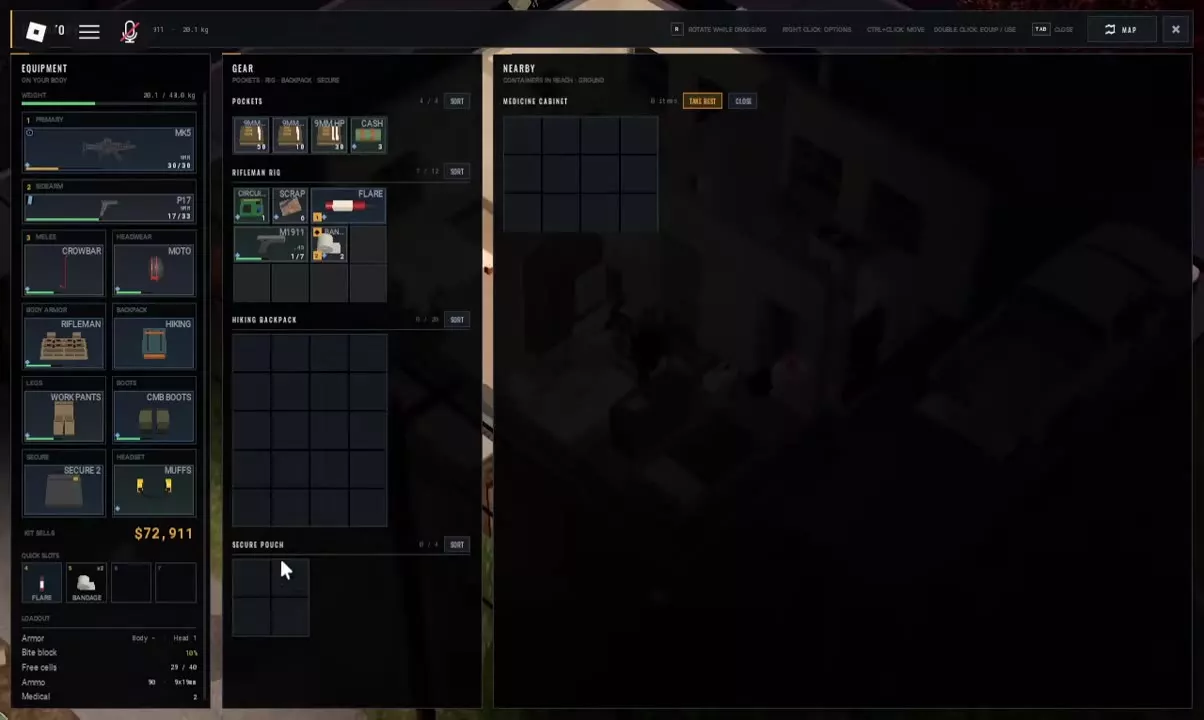
The standard Secure Pouch is starting storage with a 2×2 grid and four protected cells. It equips in the Secure slot, where its equipment label reads SECURE 2. Its storage grid is labeled SECURE POUCH.
The paid Secure Case 3x4 provides 12 protected cells: three times the standard capacity, or eight additional cells. It is a one-time, permanent purchase.
Stay with the standard pouch if four cells cover the items you want to protect. Consider the upgrade if you regularly run out of protected space: its benefit is room for more contents, while the death-protection rule stays the same. See the game pass comparison and purchase details when deciding whether to buy it.
Put items in the protected grid
- Open your inventory or a searched container's item interface.
- Find SECURE POUCH beneath the other carried storage grids.
- Drag the item into that grid. Press R while dragging if you need to rotate it.
- Confirm that the item is inside the pouch before closing the interface with Tab.
If a move fails, check the item's footprint and the available space in that specific grid. Rearrange or rotate it as needed; empty cells elsewhere do not enlarge the pouch. For broader storage troubleshooting, use the inventory organization guide.
-

Secure Pouch
- Equipment slot
- Secure
- Secure storage capacity
- 4 cells (Standard pouch)
- Storage columns
- 2 cells (Standard pouch)
- Storage rows
- 2 cells (Standard pouch)
- Contents return after death
- Yes (Items stored in the secure case)
-
Secure Case 3x4
- Secure capacity
- 12 cells (With Secure Case 3x4)
- Capacity relative to the standard pouch
- 3 times
- Purchase terms
- One purchase, permanent
Secure Storage Is Different from Insurance
| Protection | What must be true | What happens after death |
|---|---|---|
| Secure case | The item is stored inside the case | Its contents come home despite your death |
| Insurance | The item was insured and nobody took it during the raid | It returns after the applicable waiting period |
If another player takes an insured item, insurance does not return it. INSURANCE PLUS does not remove that condition; it changes premiums and waiting time.
Choose a larger secure case when your main problem is limited protected space. Consider insurance for conditional recovery of insured gear left behind, with a delay before its return. For waiting periods, premium discounts, and calculations, see the insurance guide.
Prepare Again After a Failed Raid
After dying, wait to return to the lobby and check your equipment before deploying again. Rebuild the loadout you need for the next run instead of assuming your previous gear is still equipped.
For replacement equipment, open TRADERS → Scrapper → BUY → GEAR. Check what you can afford and what is available; the Scrapper shop guide explains purchase requirements and locked offers.
Bring gear you can afford to replace. A larger secure case protects more stored items, but losing the rest of an expensive loadout can still set you back. Use the quiet loot-run loadout guide to plan your next setup around practical supplies and a manageable loss.